My story
Foreword
I'm sharing a full, honest account of my story because I believe one person's honest telling of their life could give permission to others to take what they are also experiencing seriously. This is my invitation to take a glimpse into both what I was thinking and feeling at the time, and what I see now looking back. I hope something in my story lights up something in yours.
I think of my life in two chapters. The first one was built on a straight road — excel, prove, achieve. I sprinted on it with conviction because I genuinely believed it was the right path. The second one began when I looked up from the road and realized there was more of me that hadn't had room yet. For me, that eventually meant leaving my career and the life I’d built around it. But leaving isn’t the point of this story, and it’s not the path for everyone. The real shift started before I left, when I began paying attention to my own life instead of just racing through it.
Some people call this being "twice-born" — the moment you stop living on autopilot and begin building from the inside out instead of the outside in. I don't think the first life was wasted. I carry everything from it. But the second life is where I started choosing consciously.
First Life
Coming to the US and schools
I was born in Ningbo, a coastal city close to Shanghai in China. Growing up, I was a good student with my eyes set on the best universities in China. Then at 15, a school experience that felt deeply unjust unexpectedly changed my whole trajectory. What came from it turned out to be the first serendipity of my life: it set in motion my move to the US a year later.
I continued my high school education at Cranbrook, a boarding school in Michigan. School work or even language wasn't the problem — I was getting straight A's including English even in the first semester. What was hard was the sudden loss of structure. I was single-mindedly focused on getting into a top US university as a means to prove myself. Back in China I could excel by simply getting the highest grade possible, but the US college application had so many moving pieces that I found myself second-guessing all the time whether I was working hard and smart enough.
Below all of that, a quieter crisis was unfolding. I had always been the good student, performing what I thought people would be impressed by — and genuinely believing that's what I wanted too. Coming to the US alone at 16 was the first crack. Without a single clear path to follow, I sensed for the first time that I had no idea who I was underneath the performance. It would be years before I fully saw it.
I did get into MIT and a couple other Ivy Leagues, but now that I look back, I was so locked onto the goal that I missed what was right in front of me — one of the best art academies in the country on campus, classes I might have taken out of pure curiosity instead of strategy, and classmates I could have genuinely connected with. (If any of you are reading this — I am sorry that I was not ready to bring all of myself back then, but I'm more ready now if you'd like to reconnect in a more deeply personal way.)
In 2013 I started my undergraduate years at MIT. I took a drastically different approach — I wanted to explore, make friends, have fun. Looking back, this isn't surprising. These are the things we naturally reach for when we feel safe, and after being told my whole life that everything would fall into place once I got into a top college, I finally felt safe. I switched intended majors more times than I can count — mechanical engineering, political science, architecture, electrical engineering.
But the exploration didn't last long. The first time I went to the on-campus career fair, 90% of the booths had either a visible or invisible sign: we want Course 6 (MIT-speak for Computer Science). I hadn't yet found anything I was truly passionate about, and computer science seemed like the safe choice that kept options open. So I defaulted.
To be completely honest, I never became comfortable writing code, because I never actually cared enough to really learn. But my grades were flawless enough to get into the first batch of Tau Beta Pi, a GPA-based honor society where I met my now-husband — arguably the only thing that stuck from Course 6.
The pattern of excelling at something I chose for optimization rather than genuine curiosity carried me straight into McKinsey after graduation. It was highly coveted, it kept options open, and it didn't require coding. Every box checked. It felt exactly the right move.
From consulting to product management
After graduating undergrad in 2017, I was a generalist business analyst for 2 years, and then a product manager for another 1.5 years at McKinsey. I then went on to spend 3.5 years at Samsara as a product manager, went through an IPO, rotated through 3 products including a zero-to-one build (the kind of work I’d been chasing the whole time), before I finally left what people would generally refer to as “work” towards the end of 2024.
The first two years at McKinsey are already a bit of a blur. One particular day comes up vividly. I took a 7AM flight to New York for a due diligence study and didn't leave the office until past midnight. My now-husband had been waiting in the hotel lobby for over three hours because I'd told him I'd be able to get out by 9PM (to continue working from the hotel room). I questioned "what for" that night, clenched my teeth, and went on grinding the following day. Compared to many of my peers I had it relatively easy — I was efficient and decent at pushing back, and probably only had a handful of those nights during my two-year stint. But it was clear to me pretty quickly that I didn't want to do this for another 10, 20 years.
Product management in tech was what I identified as my best next step. Better work-life balance, a computer science background I could leverage, strategy and problem-solving I genuinely enjoyed, and the "mini-CEO" framing sounded fun. McKinsey had an internal PM rotation that gave me the stepping stone I needed. My plan was to recruit immediately, but Covid shut down tech hiring in 2020, so I finally made the jump in early 2021.
Samsara checked every single box. Growth-stage but not too early for my H-1B situation. Pre-IPO for the financial upside. Permanently remote so I didn't have to move away from New York. A team I genuinely liked — I was so close with the Engineering Manager that he flew from SF to Italy for my wedding in 2023. And a product awaiting a major refresh, which meant plenty of room for the creative strategy work I craved. I remember feeling like I had solved the equation perfectly.
I stayed three and a half years and rotated through three products at different stages — the first one a refresh, the second an ultra-high-stakes core revenue source, the third a zero-to-one build. I was comfortable at the first, burned out at the second, and exhilarated at the third. Three lives at one company called Samsara — the Sanskrit word for the endless cycle of rebirth. The irony isn't lost on me. Nirvana, in the Buddhist tradition, is the escape from that cycle. I wasn't there yet.
Before I write about my second life, which I will actually start by giving a more detailed account of my last two years at Samsara, I want to acknowledge two things. First, if I were given a chance to restart life with all the knowledge I have today, I would say thank you but no. I am deeply grateful for all the celebrations and sufferings that happened along the way to make me the person I am today, and I believe every single laugh or tear was necessary for my personal growth. Second, I do not think I'm parting ways with the Shirley that was born in 1993. I am moving forward with a newfound awareness and honesty in my twice-born life, but I also take with me everything I have picked up along the way — knowledge, work ethic, genuine human connections, and the "go-getter" attitude that I will very much still draw strength from.
(Sorry no picture for this section. I searched my phone up and down but really can’t find anything. Apparently I was too busy to document it. I promise all the following sections will have photos. )
Second Life
Last 2 years at work
I left my Samsara PM job in September 2024, but I consider 2022 to be the start of my second life.
2022 was the year that I finally got my US green card, after 12 years of living in the US. I still remember my very first reaction when I got my green card approval - now I can quit my job! It took me another two years before I finally decided to leave my job, but I would say that the day of my green card approval was also the day I was second-born because I felt safe, and hence free.
Nothing changed externally, but with the green card approved I was able to shift from “how can I keep this job” to “what do I want” and “how can I make this job work for me”. Now looking back, my burnout symptoms actually did not fully surface until then, probably because my pre-green-card mind was mercilessly clamping down any inklings that would make me “weaker”. Towards the end of 2022 I started to dread meetings, to the extent that I would cry during work days, and needed to give my 120% just to prevent myself from bursting into tears during work meetings.
I was ready to quit in January 2023, not out of aspiring for something bigger but simply because I could not take it anymore. The first meeting I had with my therapist I barely said anything and cried for a whole hour, and he said you absolutely need a break right now.
I was off work for 3 months starting February 2023. I spent a few weeks with family at the beginning, a week in Kauai at the end, and did nothing in NYC for the rest of my time in between. At the start of my break, I was stressed about how to make the 3 months "worth it." A close friend was between jobs at the same time and doing back-to-back multi-week trips to beautiful destinations, and I started getting anxious — should I be doing more with the first real break I'd had in over 10 years? I don't remember what my therapist said, but I am so grateful that I ended up settling with a "boring" break. It was during that boring in-between time that my second life started to take root.
One of the concepts that my therapist at the time taught me was the “happiness box”. Up until this point, I evaluated whether a day was good based on how productive I was – and I was miserable towards the end because despite giving 200% effort I was only able to achieve 50% of my own expectation. It was not natural to attend to my own happiness, and I needed some vocabulary that I was familiar with such as “task.” I started intentionally carving out space to do “tasks” whose sole purpose was to fill my happiness box, such as laying down in the sun listening to music on the little island, or to take myself out to sugarfish to eat a solo lunch. Slowly but miraculously, I sensed the early growth of my second identity – my first identity was what I achieved, and my second identity was me, just me, all of me.
This shift didn't require changing anything external. I didn’t reinvent my circumstances. I just started paying attention to what was already there — what made me happy, what drained me, what I'd been too busy optimizing to notice. It turns out that waking up inside the life you already have can be just as transformative as building a new one.
I went back to Samsara in May 2023. Honestly, I was skeptical how long I’d last — I half expected the burnout to return the moment I opened my laptop. But something had shifted in that 3 months of pure “being”. The burnout was gone, and what replaced it wasn't just relief but genuine motivation that came from inside rather than sheer discipline. And what I had for the next year was the closest thing to a dream PM job: I was a de-facto entrepreneur bringing a brand new product from beta launch to millions in recurring revenue, with near-full agency and the resources of an established company behind me. Hours-wise I was working way more than when I'd burned out, but I was energized, doing good work, and telling my friends I had the perfect job.
So what happened? Why did I choose leave when everything seemed to have finally worked out?
For almost a year, it worked. Then the conditions around me changed — the agency I'd had was pulled back, and as a result the work became something I had to push through rather than something that pulled me forward. This time, instead of wanting to fight for the perfect setup again, I felt something closer to relief that the illusion had broken. The truth was, I had been solving for the perfect setup instead of actual problems I cared about. Once that fell away, I could see that the fulfillment from my PM work had been real but narrow — closer to 20% — from the entrepreneurial and creative part. The other 80% was things I was good at but had never been innately motivated to do. For a moment I had the instinct starting to optimize again — how to make this job work, how to get another PM job in a different company with even better setup — but I was also feeling it’s not worth it to move the fulfillment barometer from 20% to 30%.
So when the opportunity came to manage a different product, I said no. For the first time, I didn't reach for the next checklist. I chose to find out who I could be without one. At the time, it felt like the clearest, bravest, and most honest decision I'd ever made.
Looking back, things didn't work out because I was brave. I didn’t see it clearly at the time, but I'd in fact been quietly building a life that was already alive before I left. That understanding only came in the year and a half that followed, and I'll share more in the next chapter. But if there's one thing I'd want someone standing where I stood to hear, it's this: you don't have to leap and hope. You can build the ground first.

Career break
My last day at work was September 27, 2024. With three months left in the year, I told myself and others that I wasn't going to think about what's next until 2025. I spent a month as a full-time beginner surfer in Hawaii, two weeks hiking and eating in Japan, and then it was the holidays.
Leaving the corporate world wasn't all birds singing and flowers blooming. The identity loss was harder than I expected. I stopped attending a yoga class I loved because after seeing me at midday sessions for months, my instructor asked me, "Shirley, what do you do for a living?" I sheepishly said I was taking a sabbatical and stopped showing up. I still love him — he's one of the most amazing instructors and has so much capacity for love.
But I realized that losing the answer to "what do you do" was genuinely painful, even as I tried to tell myself it was a zeroth-world problem. And yet, underneath the pain, something else was there, and it was empowering. For the first time in my life, I had chosen consciously. I chose to navigate the difficulty of identity loss and uncertainty instead of letting the conveyor belt carry me forward. I chose the possibility of who I might become over the comfort of who I already was. That is a choice I would make over and over again.
At the start of 2025, just as I’d promised myself, the question of "what's next" hit me. For the first week of the year, I thought about continuing as a PM at an earlier stage startup, or transitioning into design for more creative work. And then I caught myself asking: what would I do if I'm not afraid? The answer was I don't know, but probably neither of the above. I realized I was about to look for a job that would get me to 30% fulfilled instead of 20%, out of fear, and I stopped myself. The urge to go back to a similar environment never returned.
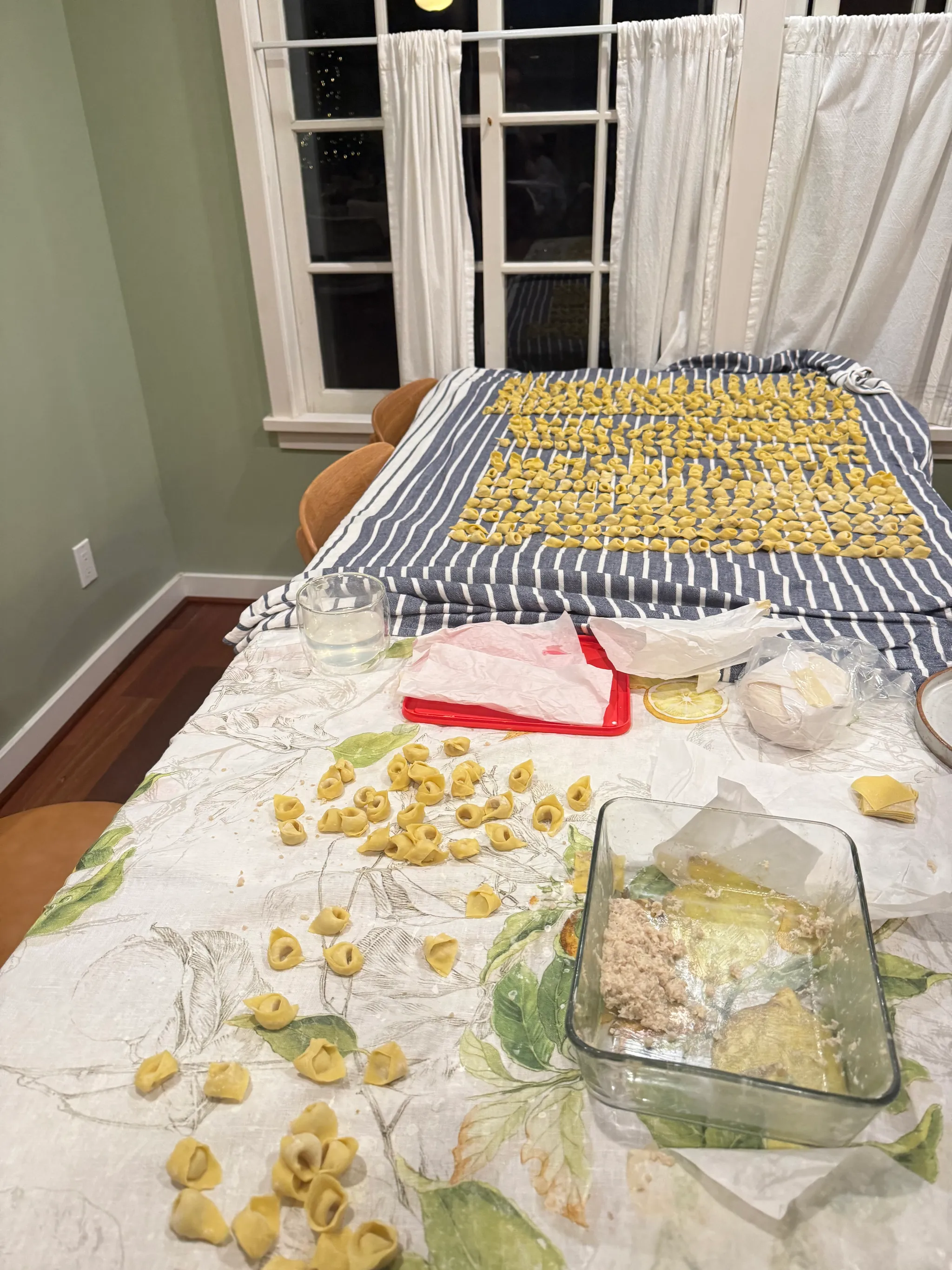
I spent 2025 without a full picture of what my life was going to look like. I dove into rabbit holes I never would have explored while working — the kind that took me inward rather than forward (more to come in the next chapter). And the part I'm most grateful for was putting down roots in my Hawaiian community: four months on the island, a place I could call home, surfing friends made by showing up at the same break day after day, and being part of an 'ohana that pulled together a 40-person wedding from scratch within a week. The only downside is that I swear to never make tortellini by hand ever again in my life. (pictured below — it was a lot)
I was genuinely happy living and exploring in what some might call a year of uncertainty. Now looking back, I realized that I could spend it that way because leaving my career didn't create a void, but instead created space for a life that was already alive before the transition happened.
The happiness box, which I'd kept up daily since my 2023 break, taught me to make space for my own needs. Mindfulness taught me to pay attention to what was actually happening inside me. Therapy taught me to be gentle when I wanted to blame myself. I'd also built anchors that made me feel alive outside of my career: my body, the ocean, or simply just being in Hawaii. And underneath all of it was my husband, who for over a decade had loved me in a way I didn’t know was possible — without judgement, without agenda, without trying to fix or steer. I was loved growing up too, but it was a love that wanted to help me become better. His was a love that honored who I am. That difference gave me room to let all the rest take root.
In a sense, leaving my career was not really a leap. The life that made me feel alive was already there before the transition — I just stopped confining it to the margins of my day or year and let it become the whole thing. And instead of searching for what was next, I just stayed radically available with the extra time at hand: I tried things, noticed what gave energy, and gave those things more room.
What came next
Earlier in this story I mentioned diving into rabbit holes and trying things following my energy. Here's what that actually looked like.
The first one found me while I was still working. In the summer of 2024, a friend introduced me to Marshall Rosenberg's nonviolent communication (NVC). Despite its name, it's not about communication at all. It's a philosophy of compassion — the idea that human beings are meant to contribute to each other's wellbeing willingly, out of joy, never out of guilt, shame, fear, or obligation.
I couldn't put it down. It gave me the language to describe the quiet dissonance with what I’d grown up inside of. I drove myself to relentlessly excel with the fear of not being good enough, and the guilt over everything I had been given. The way I'd learned to suppress my own needs because having needs meant being weak, and being weak meant being unsafe. NVC talks about "domination structures" — systems that train people to disconnect from their own feelings and look externally to know if they're good or bad, right or wrong. Reading that, I felt a jolt of recognition. That was the education system I grew up in, the parenting I was raised with, and the corporate environment I'd spent a decade navigating. I'd always experienced these as separate chapters of my life. In fact they were all related, and the dissonance was not mine or any individual’s fault.
A few months into my career break, the thread pulled me deeper. I read Stephanie Foo's What My Bones Know, a memoir about healing from complex PTSD rooted in childhood and the intergenerational trauma of immigration. What shook me wasn't just her story — it was the moment she returned to her childhood community and discovered that behind the perfect report cards and model minority image, so many of her peers were carrying the same hidden bruises. Thanks to Stephanie’s heroic act of healing in public, I saw that what I’ve considered as private wounds may in fact be collective pain. Generations of people educated to suppress feelings, sacrifice needs, and measure their worth by achievement, passing that same compression down to their children without even knowing they were doing it.
Around the same time I also read Jenny Wang’s Permission to Come Home, written for Asian Americans reclaiming mental and emotional health. It gave me the words to spell out what I had wanted all along: permission. Permission to feel — to let emotions exist instead of treating them as weakness. Permission to play — to do things for no productive reason. I realized I'd never been taught an emotional vocabulary even in my mother tongue. I printed out a feelings list and stuck it to the wall in front of my desk like a student learning a new language.
Then in May 2025, via a serendipity I reconnected with Dou, a friend from MIT and McKinsey, now a coach helping teenagers discover their internal strengths and purpose. She suggested I check out Co-Active Training Institute. I enrolled in the intro course out of curiosity, and it rocked my world — not because it introduced something new, but because everything I'd been absorbing over the past year suddenly had a practical form. I was so hooked that I immediately went on with hundreds of hours of learning, coaching and getting coached.
When I learned about deep listening in coaching — to be fully present to what another person is feeling and needing, not waiting for your turn to speak or fix — I recognized it immediately. This was the empathy described in nonviolent communication: being with someone and hearing what's alive in them. When I encountered Process coaching — the idea that emotions aren't obstacles to clear thinking but energy in motion, fuel for transformation — I felt the same recognition. I don't coach my clients away from difficult emotions. I help them stay, explore, name, discover what's underneath, and then move towards what matters with renewed energy and perspective. The very thing I'd been trained my whole life to suppress — my emotional life — turned out to be one of the sources of the deepest work.
With my own coach Abigail, I found out about the bigger and deeper reason I’m pulled towards coaching with such intensity. It wasn't about coaching as a career. It was that coaching gave me tools to work with something I'd felt powerless against: the collective weight of a cultural inheritance that had shaped how I thought about achievement, worth, love, and what it means to be a good daughter, a good employee, a good person.
And something unexpected happened alongside the healing. Behind the weight, I found something I hadn't looked for: a genuine curiosity about and love for my cultural heritage. Not just the wounds, but the richness — philosophies, traditions, ways of being that existed long before the patterns I'd been unlearning took hold. Taoism, which I'd barely paid attention to growing up, suddenly felt alive and resonant. I'd spent years running from my Chinese identity, equating it with the parts that hurt. Now I am on my way back to the parts that nourish.
But what moved me most from this whole journey was about scale. I used to think that the "big" work — healing intergenerational patterns, finding meaning and happiness, transforming how I relate to my own life — happened somewhere separate from daily existence. That I had to go looking for it, and ordinary moments were just noise to get through on the way. What I learned through coaching is that the particular moment is the portal. The way I pull back instead of saying “no” is not a minor personality quirk, but directly connected to a belief that I'm not enough unless I give the other person everything they want. And the act of making a different choice in that moment — staying present, saying what's true with respect to both of us — isn't just handling a situation. It's rewiring the pattern at its root. The small is the big. This Tuesday is the whole thing. I used to rush past moments because they felt insignificant compared to some larger truth about meaning and happiness. Now I see it the other way around: there is no larger truth that isn't lived in moments.
I've thought a lot about when the Coach Shirley could have helped the earlier versions of me. Not before I was second-born — I was too focused on external measures to look inward. Not during my burnout — what I needed then was healing and rest, and therapy was the right support. Where coaching could have made a difference was after I returned to work, when I'd checked every box of what I thought I wanted but still felt a quiet dissonance. I'm grateful I had the time and conditions to stumble into each of these discoveries on my own. But the journey from first sensing something was off to actually arriving here took years — burnout, a leave, a career break, and a lot of searching. I coach now because I hope it doesn't need to take you as long.
A little more thoughts came up after I finished writing my story:
I don’t know how to describe it, so I’m just going to say it plainly: I feel so happy. Not in the way I used to measure it — not productive-happy, not achieved-something-happy. I mean the kind where I'm walking to my favorite coffee shop and feel tears come up for no reason other than the sun felt so good on my skin. I feel deeply connected to my husband, to my friends, to the work I'm doing. And I make space for so much play — being in Hawaii, taking walks, or staring out of the window doing nothing. I wake up and feel fortunate in a way I never did in my first life. I want that for you too.